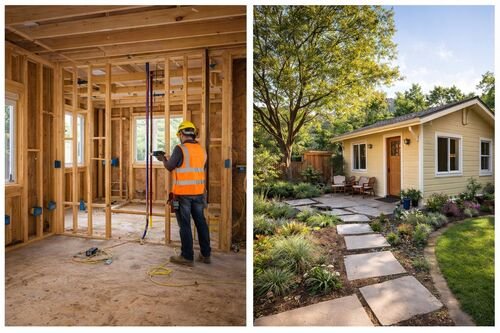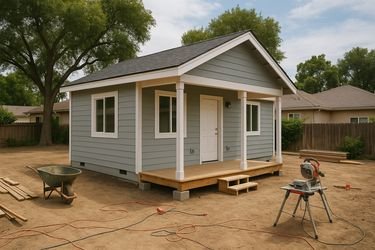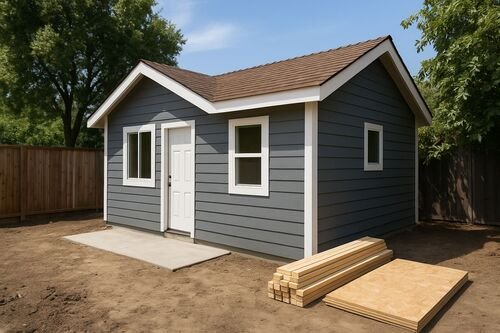
The headline numbers: complete garage conversion ADUs in San Jose and surrounding Santa Clara County cities are currently landing between $145,000 and $260,000 all-in, including design, permits, construction, and utility work. Studio conversions of standard two-car garages cluster near the bottom of the range; conversions that add bathrooms with long plumbing runs, expand the footprint, or require significant structural and electrical remediation populate the top. The report’s purpose is to show each homeowner which of those cost drivers their specific garage carries before they fall in love with a floor plan.
Where the Money Actually Goes
The report divides a typical $180,000 conversion into its real components. Design, engineering, and permits consume roughly ten to twelve percent. Foundation and structural work, slab moisture barriers, sometimes slab replacement, shear wall upgrades, new headers where garage doors come out, runs ten to eighteen percent depending on the building’s condition. Plumbing is the great variable: a garage sharing a wall with an existing bathroom might connect for under $15,000, while a detached garage sixty feet from the sewer lateral can see $30,000 or more in trenching and connection before a fixture is set. Electrical, including the panel work most older homes need, runs $15,000 to $35,000. The remaining half of the budget is the unit itself: insulation, drywall, windows, flooring, kitchen, bathroom, HVAC, and finishes.
Two line items surprise homeowners consistently. First, the garage door opening: removing the door, framing the wall, and matching the house’s exterior finish is skilled work that reads as a four-figure job and prices as a five-figure one once structural headers and stucco or siding blending are done properly. Second, Title 24 energy compliance: bringing an uninsulated concrete box to current California energy standards, insulation, glazing, heat pump HVAC, and often a heat pump water heater, is a five-figure category on its own, and it is also precisely why finished conversions are comfortable and cheap to operate.
The full report, along with the company’s conversion portfolio and consultation scheduling, is available through adubuildersbayarea.com.
Attached Versus Detached, Priced Honestly
The report prices the two garage types separately because they behave differently. Attached garages win on utility proximity, plumbing, power, and heating connections are steps away, and lose on sound separation and entry privacy, which cost money to solve well. Detached garages win on privacy and rental appeal and lose on trenching, with every utility crossing the yard. On the company’s recent projects, equivalent finished quality has run $10,000 to $25,000 more for detached conversions, a gap homeowners routinely accept because detached units rent faster and at stronger rates in most South Bay neighborhoods.
Condition matters more than type. The report includes a pre-conversion checklist of the conditions that move budgets: slabs that slope toward the old door and need leveling or replacement, roofs within five years of replacement age that should be done during conversion rather than after, knob-and-tube or undersized electrical feeds, unpermitted past modifications that must be unwound, and termite or moisture damage hidden behind stored boxes for decades. The company inspects all of these in its initial assessment and prices them explicitly, because the alternative, discovering them mid-project, is how conversions earn their internet horror stories.
Why Conversions Dominate the Winter Calendar
The report’s timing is seasonal and deliberate. Garage conversions are the one ADU category almost immune to the Bay Area rainy season: the structure stands, the roof sheds water, and crews work inside from the first day. The company loads its November-through-March calendar with conversion work for exactly this reason, and homeowners who contract this fall can realistically hold a finished, rentable unit by late spring 2027, a timeline no detached new build started in the same week can match.
Permitting also favors the category. Conversions of existing space enjoy some of the strongest protections in California ADU law: cities cannot require new parking to replace a converted garage, setback rules that would block new construction do not apply to existing footprints, and the ministerial sixty-day review clock applies as it does to all compliant ADU applications. San Jose’s permit counter processes conversion submittals routinely, and the company’s recent conversion permits have issued in four to seven weeks from complete submittal.
“A garage conversion is the most honest bargain in Bay Area housing,” said a company spokesperson for ADU Builders Bay Area. “The structure is paid for, the roof is on, the rain does not matter, and the city cannot demand parking for a car that now lives in the driveway anyway. Homeowners who sign this fall are collecting rent by summer. The ones who wait for spring join the queue behind everyone else who waited for spring.”
The Rental Math Behind the Costs
Costs mean little without the income they buy, so the report pairs its budgets with current rental figures. One-bedroom garage conversion units in San Jose neighborhoods are leasing in the $2,200 to $2,900 range depending on location and finish; studios run several hundred dollars less. Against a $180,000 all-in conversion funded on home equity, typical projects reach positive monthly cash flow quickly and recover their capital in six to nine years at conservative assumptions, before counting the unit’s contribution to resale value, which Bay Area appraisers increasingly recognize at or near construction cost for permitted, well-documented units.
The report is equally clear about what a conversion is not. It is not a way to create a luxury unit, the footprint is fixed and modest. It is not invisible to the assessor, the new construction triggers a supplemental assessment on its value, though the main home’s Proposition 13 base is untouched. And it is not a weekend project wearing a permit: the gap between a code-compliant conversion and a converted garage is the gap between an asset and a liability at resale, and lenders, insurers, and buyers now check.
A Worked Example From the Report
The report walks one recent project end to end. A 1972 ranch house in West San Jose with a 440 square foot attached two-car garage became a one-bedroom unit with a compact kitchen, full bathroom, in-unit laundry, and private side-yard entrance. The budget: $168,000 total, including a panel upgrade to 200 amps, slab moisture remediation, a ducted mini-split, and mid-range finishes chosen for rental durability. Design to permit took nine weeks; construction took fourteen. The unit leased eleven days after final inspection at $2,450 a month to a nurse at a hospital ten minutes away, and the homeowners, who built it to eventually house a parent, bank the rent in the meantime. The report presents the project’s actual draw schedule and the three change orders it absorbed, totaling under four percent of contract, as a realistic picture of how a disciplined conversion runs.
How 2026 Pricing Compares to Recent Years
The report situates this fall’s numbers against the recent past. Conversion costs in the South Bay rose sharply through 2022 and 2023, flattened through 2024 and 2025, and have been broadly stable through 2026, with material prices calm and the labor market, while still tight, no longer escalating quarter over quarter. Adjusted for the finish levels homeowners now choose, the company’s average conversion price has moved only a few percent in two years, which it reads as a window: costs are predictable, lenders are comfortable with the category, and city processes are the smoothest they have ever been. Homeowners who remember 2021 pricing will not see it again, but homeowners fearing another escalation cycle can contract this season against known numbers.
The report also flags the costs most likely to move next. Electrical switchgear lead times and utility service upgrade queues remain the category’s least predictable inputs, one more argument for filing panel and service applications at the start of design. Heat pump equipment, briefly scarce two years ago, is now readily available across the spec range the company installs. And the trades most in demand for conversions, finish carpentry and tile, book out furthest in spring, which is precisely why the company steers conversion starts into the winter months when those crews are most available and most attentive.
Getting a Garage Assessed
The company offers free garage assessments throughout its service area this fall. The visit covers structure, slab, utilities, sound and privacy strategy, and a frank read on whether the specific garage supports a conversion worth doing; a written budget range and timeline follow within days. Homeowners whose garages assess poorly are told so directly, along with what alternative, a detached unit, an attached addition, or nothing this year, the property better supports.
Homeowners across San Jose, Santa Clara County, and the greater Bay Area who are weighing a garage conversion are encouraged to contact ADU Builders Bay Area to schedule an assessment while winter construction capacity remains open. The company provides guidance on feasibility, design, permitting, and construction scheduling, and its team works with each homeowner to match the project to the realities of the garage, the lot, and the budget.
About ADU Builders Bay Area
ADU Builders Bay Area is a San Jose based accessory dwelling unit builder serving homeowners throughout the Bay Area. The company provides ADU design, planning, permitting, and construction services for detached ADUs, attached ADUs, garage conversions, junior ADUs, backyard cottages, in-law units, and custom secondary housing structures. Its work is centered on local expertise, efficient project delivery, and functional residential design for California homeowners.
ADU Builders Bay Area
111 N Market St Suite 378
San Jose, CA 95113, United States
Phone: (669) 288-5648
https://adubuildersbayarea.com
About the Author