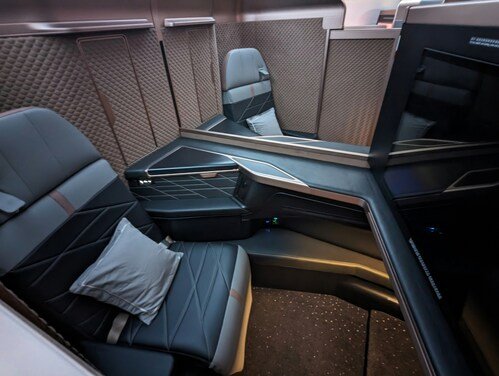
Over the past decade, business class has improved dramatically. Fully flat beds, direct aisle access, private suites, and high-quality dining have become standard on many long-haul routes. For most travelers, business class now delivers everything they need for a comfortable journey. Yet first class has not disappeared. In fact, a small number of airlines continue to invest heavily in it. This raises a natural question: if business class is so good, why does first class still exist? The answer lies in how airlines think about exclusivity, privacy, and the psychology of premium travel.
Why First Class Still Exists
First class exists because there is a small but consistent group of travelers whose needs go beyond comfort alone. While business class focuses on efficiency and rest, first class is designed around space, control, and personalization.
From an airline’s perspective, first class also plays a strategic role. Even if only a few seats are sold per flight, those seats generate strong margins and reinforce brand positioning. Airlines like Emirates, Singapore Airlines, Lufthansa, and Air France use first class as a flagship product that defines the top of their service pyramid.
Another reason that the first class survives is differentiation. In a world where many business class products look similar, first class allows airlines to stand apart. Private terminals, onboard showers, enclosed suites, and dedicated crew-to-passenger ratios are features that business class cannot realistically replicate at scale.
This is why first class flights are typically limited to specific long-haul routes and flagship aircraft, rather than offered across an airline’s entire network.
The Psychology of Ultimate Privacy and Space
First class is not just about better service, it is about how space and privacy affect the traveler’s mindset.
In first class, passengers are often physically separated from the rest of the aircraft. Some airlines offer fully enclosed suites with doors, individual wardrobes, large dining tables, and even separate beds. This creates a feeling of personal territory rather than shared space.
Psychologically, this matters. Travelers are not simply resting; they are disconnecting. Noise levels are lower, movement around the cabin is minimal, and interaction with other passengers is limited. For people who spend their lives in meetings, crowds, and shared environments, this isolation is valuable.
Airports reflect the same logic. First class travelers may have access to private check-in areas, dedicated security lanes, and exclusive lounges or terminals. These features remove friction and decision-making, allowing travelers to move through the journey with minimal effort.
In this sense, first class is designed to reduce cognitive load. The traveler does not need to adapt to the environment, the environment adapts to them.
Who First Class Is Really Designed For
Despite popular belief, first class is not designed for “luxury travelers” in the traditional sense. It is designed for very specific use cases.
First class is most commonly used by:
- Ultra-high-net-worth individuals
- Executives with extreme time sensitivity
- Public figures requiring privacy
- Travelers on long, complex, or high-stakes journeys
For these travelers, the value of first class is not measured in amenities, but in outcomes. A quiet environment, guaranteed rest, and seamless ground handling can directly affect performance, security, or well-being.
It is also worth noting that first class cabins are shrinking, not growing. Many airlines have removed first class entirely, choosing instead to enhance business class. This reflects reality: business class satisfies the needs of most premium travelers.
First class remains because a small group of travelers values absolute control over space and time, and is willing to pay for it.
In today’s aviation landscape, business class is the practical premium standard. First class exists above it not as an upgrade, but as a separate category altogether.
It is not about better food or a bigger screen. It is about privacy, predictability, and removing friction from every stage of the journey.
That is why first class still has a place in a business class world not for everyone, but for those who need the very top of the experience.
About the Author